‘Driving force’ for product strategies and development processes
‘DRIVING FORCE’ FOR PRODUCT STRATEGIES AND DEVELOPMENT PROCESSES
The year 2025 is already drawing to a close, marked by many global political and economic influences and uncertainties. Many of our customers are currently defining their project roadmaps and development processes for the coming years – a demanding and complex challenge that we at BUSSE Design+Engineering are ideally placed to support thanks to our broad industry diversity and interdisciplinary development experience.
It is now more important than ever to critically reflect on and strategically develop the product portfolio, to create customer loyalty and added value with digital ecosystems in symbiosis with the product world, to invest in the ‘right’ innovation approaches – usability-driven and not just technology-driven – and to select these in advance in a structured manner; and, conversely, consciously streamlining and segmenting product complexities that have grown over time in order to remain competitive and open up new markets. 
Optimise product development processes
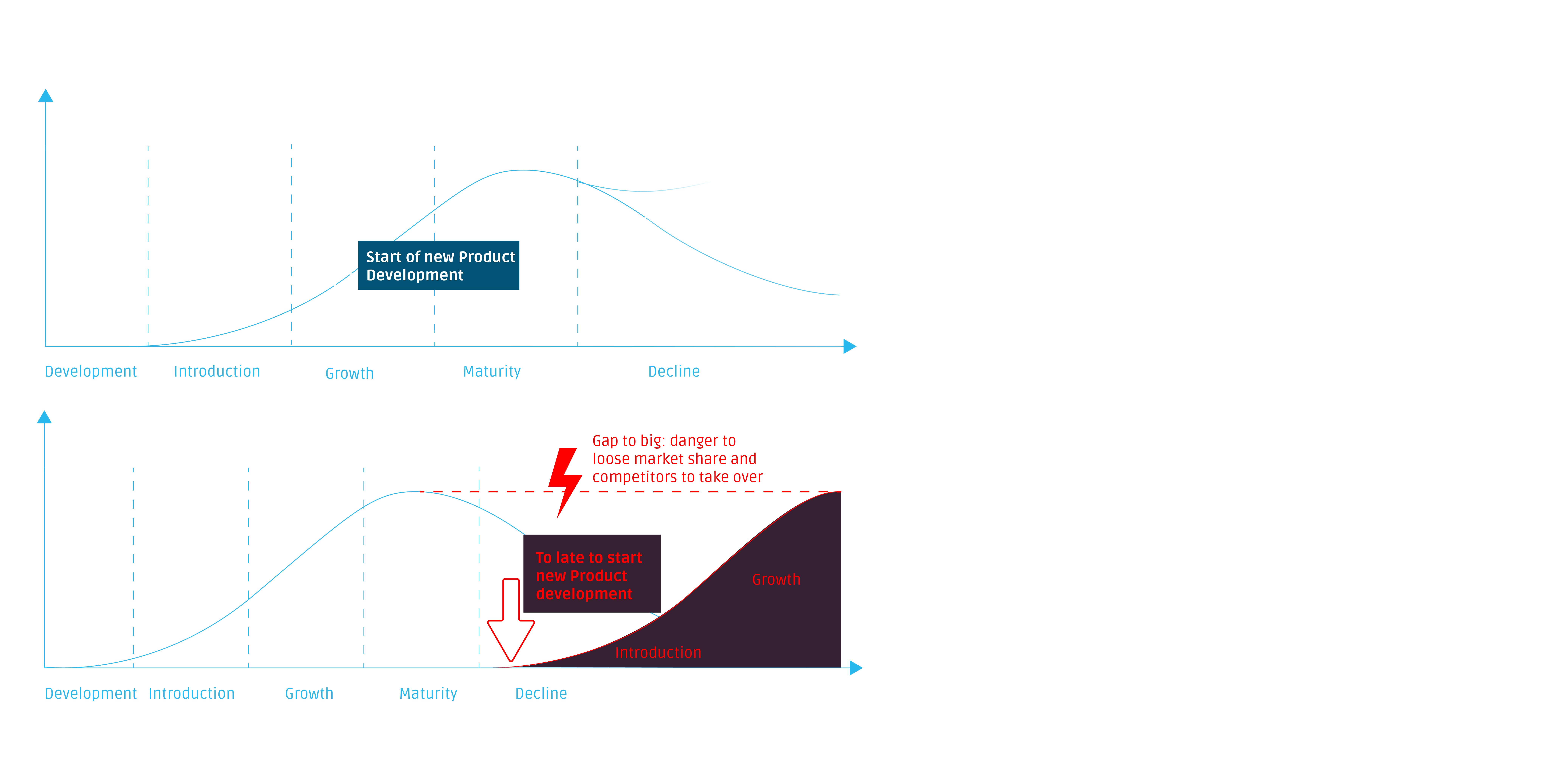
In order to be able to implement upcoming projects in a future-proof and successful manner, product development processes must also be adapted:
The rigid project processes of the past with predefined specifications no longer work due to increasingly complex and dynamic requirements, influencing factors and diametrically opposed stakeholders. The definition phase takes too long, and one becomes ‘entangled’ in theoretical and competing target requirements. All project participants are overwhelmed by the complexity and often develop products that are not in line with the market.
On the other hand, purely agile processes and completely free ‘design thinking’ lead to endless concept loops, there is no real commitment to a defined product setup and there are no clear obligations during the course of the project. Nothing gets finished.
Define clearly defined work packages and conceptual theses
Studies show that the failure rate increases disproportionately as projects and requirements become more complex. The trick is therefore to break down the various requirements and approaches of the project into small, clear packages so that concept approaches can be examined and risks identified and eliminated in short sprints. These sprints and their findings must be presented in such a compact form that management and project participants can quickly grasp the information, make clear decisions and incorporate the input into further packages. To this end, we at BUSSE are currently supervising a master's thesis in innovation engineering at Furtwangen University.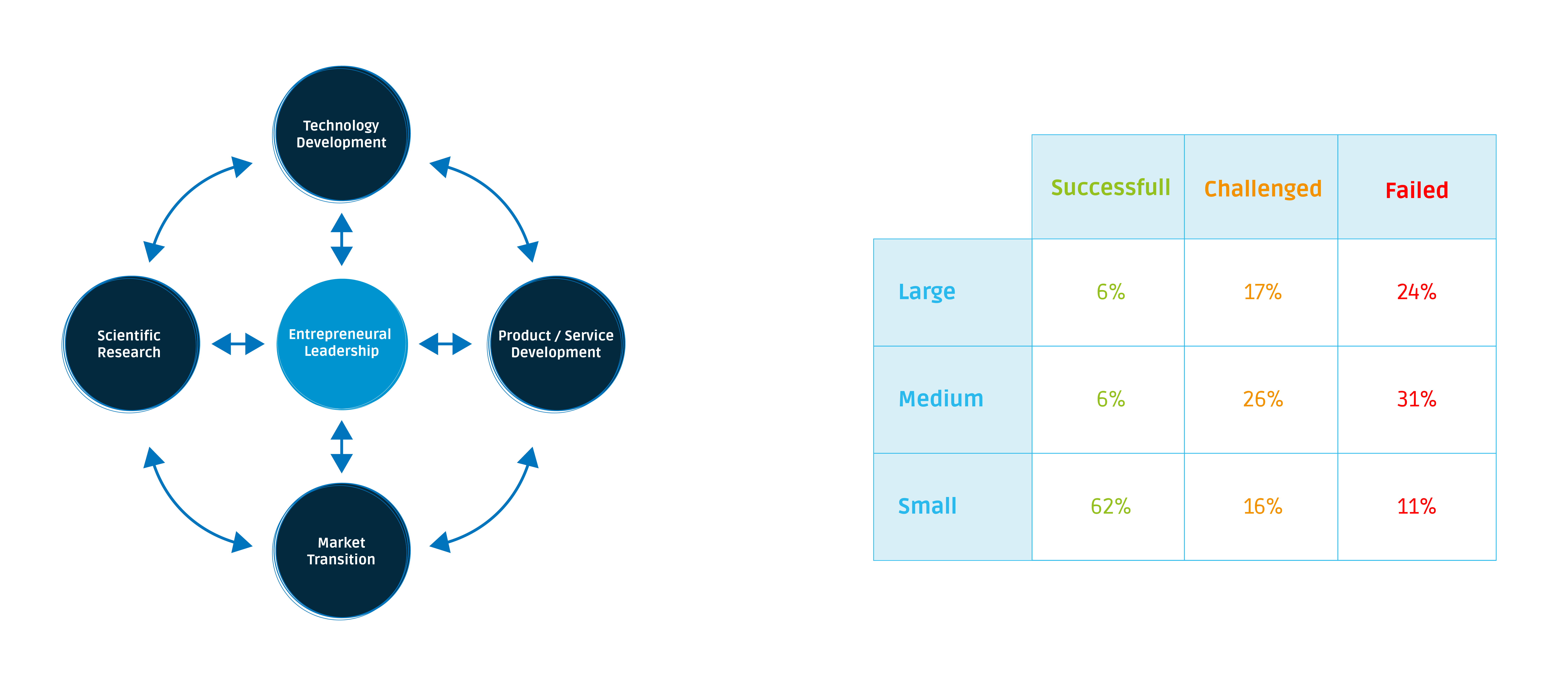
Interdisciplinary project teams
With increasing complexity, it is all the more important that project teams are put together on an interdisciplinary basis and that the individual players have as broad an understanding as possible of the other ‘trades’ in order to develop the most ideal product configuration possible. After all, what you cannot see, understand or take seriously cannot be incorporated into a coherent concept.
The sequential work of individual departments and traditional individual service providers such as the construction department, design office, control development, software programming, etc. leads to loops and costs a lot of time. Weekly ‘JourFixes’ with all project participants, where often no one is properly prepared, no one takes notes and the same topics are discussed over and over again, are more counterproductive than helpful. This does not mean that JFs cannot be a good tool: they just need to be consistently moderated, precisely presented, discussed in a goal-oriented manner and well documented.
BUSSE – the perfect partner for your projects
At BUSSE, we combine all the processes and expertise necessary for successful product development in a well-coordinated, efficient and interdisciplinary team under one roof: From design, usability and HMI experts, product and UI designers to prototype construction with extensive expertise in a wide range of manufacturing processes and a corresponding network of manufacturing partners from over 65 years of product development activity.
In our work processes and experience from over 200 projects per year, we combine the ‘best of both worlds’: high agility with structured creativity at the start of the project and absolutely strict processes with a DFM focus in the implementation phase. This is the only way to turn ideas into successful series products.
We would be delighted to support you in your project plans:
in the early stages of exploration, innovation, product conception and definition
in research to identify user value and enthusiasm factors
through UX checks, interviews or benchmark analyses
in the implementation of operating concepts and digital add-ons based on human-centred design
in the development of brand-defining design constants in both products and interfaces
as a resource extension and conceptually strong sparring partner in construction and development
in series production transfer and DFM design for manufacturing
in the construction of physical and digital prototypes, tech demonstrators and trade fair models
Please contact us!

Our expertise is not only proven by 400+ awards, but also by the enthusiasm of our customers.